
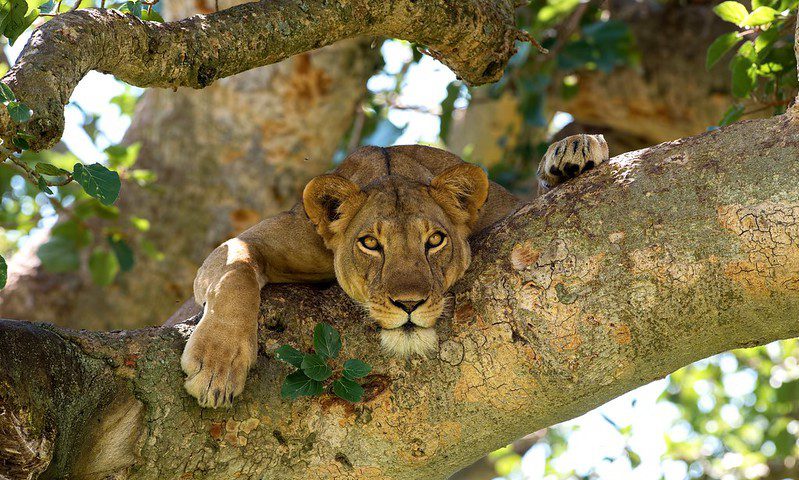
Uganda Tree Climbing Lions
Uganda Tree Climbing Lions are the biggest cats that still inhabit the African wilderness. Lions, in general, help to sustain the number of herbivores such as buffaloes and various antelope species, which helps to balance the ecosystem. Lions also hunt weaker and sicker animals, which helps keep illnesses and parasites at bay. Unfortunately, the entire lion population in Africa has declined significantly, with just approximately 25,000 lions remaining in the wild. A century ago, there were over 250,000 lions roaming the African savannah. Tanzania Safari Tours.
Human meddling is the primary reason for this significant decrease in quantity. Because of the increased human population, lion territory has shrunk as more land is cleared for cultivation and habitation. Lions have also been victims of poaching and new illnesses spread by more domestic animals in close proximity, all for the excitement of Uganda Safari Tours.
Uganda is one of Africa’s remaining lion strongholds. Lion sightings have been reported at Queen Elizabeth National Park, Murchison Falls National Park, and Kidepo Valley National Park. Queen Elizabeth National Park, Uganda’s most visited park, is home to 130 of the country’s 400 lions. Unlike the drier Maraa in Kenya, the park receives adequate precipitation and keeps its picturesque charm for most of the year. The park is also notable for its amazing terrain (Maramagambo forest, Kazinga channel, craters, and Kyambura canyon), birdwatching population, and animals, particularly the uncommon tree-climbing lion, which is one of Uganda’s top tourist attractions.
You might be interested in learning about the greatest spots in the world to observe lions, such as the Tree-Climbing Lions in Uganda.
Tree-climbing lions are quite rare as adults. Most lions avoid trees until they reach a certain size unless they are encircled by a herd of buffalo, and climbing a tree is the only way to escape. Tree-climbing lions are mostly found in Uganda’s Queen Elizabeth National Park and Tanzania’s Lake Manyara National Park. Individual lions have also been spotted climbing trees in Tanzania’s Serengeti National Park and South Africa’s Kruger National Park. These are, however, uncommon encounters that cannot be compared to those in Queen Elizabeth National Park or Lake Manyara National Park.
An entire pride may be sighted on a tree in the Ishasha sector of Queen Elizabeth National Park, making Queen Elizabeth National Park the finest area to spot tree-climbing lions. Most lions prefer to stay on the ground, leaving tree climbing to their young or other smaller cats such as leopards. The lions at Queen Elizabeth National Park, on the other hand, have departed from their typical routine and may be observed in the early afternoon dozing among acacia and fig trees.
Lions climb trees for what reason?
There have been several explanations presented to explain this unusual conduct. Some people think that lions, like other cats, have an innate aptitude to climb trees. Climbing trees should come as no surprise considering that they, like other cats, have keen claws. Others think that the lions of Ishasha learned this habit from previous generations of lion prides. Some lion experts believe that lions climb trees to avoid attacks from pests and insects that reside on the ground, such as tsetse flies and mosquitoes. The researchers also believe that lions climb trees to avoid the noon heat on the ground, which is especially prevalent during the dry season.
The leaves and tree branches provide a refreshing wind and reprieve from the afternoon heat. The lions may receive undisturbed repose while simultaneously monitoring their areas for prey and other rivals like hyenas and leopards by ascending to the tops of fig and acacia trees. Whatever the cause for the lions’ interesting habit of climbing trees, the lions draw an increasing number of tourists to Queen Elizabeth National Park each year.
Other activities at Queen Elizabeth National Park
The Ishasha grasslands of Queen Elizabeth National Park are famous for their tree-climbing lions, but there are a variety of other activities available while there.
Cultural Outings
A visit to the local Bakiga community may be requested while at Ishasha. A tour opportunity conducted by a woman Agartha was presented as part of the Ishasha community uplift programme. Agartha and her female companions will teach you about Bakiga culture and way of life. You will be brought to local homesteads and individual huts to learn how to prepare native foods (millet porridge, bananas, and so on). You can accompany the women to their gardens and assist in harvesting millet, grinding it into flour, and preparing a ready supper. Agartha and her women’s group will teach you what it means to be a Bakiga wife and how to care for your husband.
Other animal species can be seen on a game drive.
Topi (a species of antelope), Kobs, warthogs, buffaloes, elephants, baboons, leopards, various smaller antelopes, and birds such as the black coucal, compact weaver, herons, and storks live on the Ishasha plains. A game drive may be arranged to see some of the spectacular animals in the Ishasha area. If you have additional time, you may go on a game drive in the Kasenyi plains/sector to view more lions (do not climb trees), chimp trekking in the picturesque Kyambura canyon, or nature hikes in the Maramagambo forest. If you have time, take a boat trip along the Kazinga Channel to see one of the world’s biggest collections of animals and birds.
Why Uganda’s Status as a Lion Stronghold Genuinely Matters Given the Species’ Sharp Continental Decline
Since Africa’s lion population genuinely dropped from roughly 250,000 to about 25,000 over the past century, Uganda’s role as a remaining stronghold genuinely makes a visit here more meaningful than simply observing wildlife, connecting travelers directly to an urgent conservation story. All in Africa Safaris can share more about Uganda’s role in lion conservation during your visit.
How Ishasha’s Reliable Tree-Sighting Genuinely Sets It Apart From the Rarer Individual Sightings Elsewhere
Since entire prides genuinely climb trees consistently in this specific sector rather than the occasional individual seen in Serengeti or Kruger, travelers specifically seeking this behavior genuinely should prioritize Ishasha over other parks where such sightings remain far less predictable.
Why the Multiple Theories Behind Tree-Climbing Genuinely Reflect How Much Remains Unknown About This Behavior
Since researchers genuinely haven’t settled on a single definitive explanation, whether insect avoidance, heat escape, or learned tradition, this scientific uncertainty genuinely adds an element of mystery that makes witnessing the behavior firsthand even more compelling. All in Africa Safaris can share the latest research on Ishasha’s tree-climbing lions.
How Early Afternoon Genuinely Emerges as the Best Window for Spotting Lions Dozing in Ishasha’s Trees
Since this specific timing genuinely coincides with when lions retreat to branches to escape ground-level heat, travelers genuinely should plan their Ishasha game drives around early afternoon rather than the dawn or dusk hours typical of standard lion tracking elsewhere.
Why the Agartha-Led Bakiga Cultural Tour Genuinely Adds Human Context to a Wildlife-Focused Ishasha Visit
Since this community program genuinely offers hands-on participation in traditional food preparation and daily Bakiga life, travelers genuinely round out their tree-climbing lion safari with direct cultural engagement rather than wildlife viewing alone. All in Africa Safaris can arrange the Bakiga community cultural tour alongside your Ishasha safari.
How Combining Kasenyi Plains Game Drives With Ishasha Genuinely Offers Two Distinct Lion-Viewing Experiences
Since Kasenyi genuinely hosts lions behaving in their typical ground-based manner while Ishasha genuinely offers the rare tree-climbing behavior, visiting both genuinely gives travelers a fuller picture of lion behavior across Queen Elizabeth National Park’s different sectors.
Why Kyambura Canyon’s Chimp Trekking Genuinely Complements a Lion-Focused Ishasha Itinerary
Since this canyon genuinely sits within reasonable reach of Ishasha, travelers genuinely find it efficient to combine primate trekking with their tree-climbing lion safari rather than treating these as separate, disconnected trips. All in Africa Safaris can combine Kyambura chimp trekking with your Ishasha lion safari.
How a Kazinga Channel Boat Trip Genuinely Rounds Out a Queen Elizabeth Visit Beyond Ground-Based Game Drives
Since this channel genuinely concentrates one of the largest wildlife and bird gatherings anywhere in the park, a boat cruise genuinely offers a water-level perspective on species that ground-based drives through Ishasha alone wouldn’t reveal.
Why Understanding Lions’ Ecological Role Genuinely Adds Depth to Witnessing Them in Ishasha’s Fig Trees
Since lions genuinely regulate herbivore populations and remove weaker or sick animals from the ecosystem, appreciating this broader ecological function genuinely transforms a tree-climbing lion sighting from a novelty photo into a window onto a keystone species at work. All in Africa Safaris can share more about the ecological importance of Uganda’s lion population.
How Choosing an Experienced Guide Genuinely Improves Your Odds of Spotting Lions in the Right Trees
Since local guides genuinely know which specific acacia and fig trees the Ishasha prides favor, working with someone experienced genuinely increases the likelihood of a successful sighting compared to searching independently across the sector’s grasslands.
Planning Your Uganda Tree-Climbing Lion Safari
From Ishasha’s dozing prides to Bakiga cultural walks, genuinely Queen Elizabeth National Park delivers one of Africa’s rarest wildlife spectacles. All in Africa Safaris can turn this overview into a fully confirmed itinerary tailored to your travel dates.
Planning Your Queen Elizabeth Visit
The tree-climbing lions are the headline, but a Queen Elizabeth itinerary usually stretches well beyond that one sighting.
- Game Drive in Queen Elizabeth National Park — what a standard game drive circuit through the park looks like.
- Things to Do and See in Queen Elizabeth — a broader list of activities beyond game drives and the channel cruise.
- Village Homestays Near Queen Elizabeth — a community-based add-on for travellers who want more than wildlife viewing.
- Attractions in Queen Elizabeth National Park — a rundown of the park’s main draws in one place for first-time planning.
- Queen Elizabeth National Park: Uganda’s Tourism Pearl — a general introduction to why the park holds this reputation.
- Uganda Safari Groups: Queen Elizabeth Park — how a group itinerary through the park is typically structured.
- Queen Elizabeth’s Geological Diversity — the crater lakes and varied landforms behind the park’s range of habitats.
- What Is Unique About Queen Elizabeth National Park? — a direct answer for travellers comparing it against Uganda’s other parks.




No comment